First two Chicago municipal cemeteries

Two early municipal cemeteries were designed to limit burials to specific areas. 

The Chicago Tribune writes: “Finally in 1835, the town undertook the establishment of regular cemeteries. A.J. Bates, the first Chicago undertaker then appeared. Two cemetery sites were selected,  one at Twenty-Third Street (South Side Cemetery), the other at the foot of Chicago Avenue (North Side Cemetery), where the waterworks now stand. The former was never used to any great extent. The latter became the regular city burying ground.”

North Side Cemetery 1835-1847

Also known as Chicago Avenue Cemetery, the Chicago Tribune of 1897 described the cemetery as “..extended from Rush to Sand (now St. Clair) street, and from Chicago avenue (to) five blocks north.

 DeWitt_Cregier

 Dewitt C. Creiger who had to do with the removal of bodies, described the cemetery as a “most dismal place. There was nothing but sand and sand”, said Mr. Creiger. “Tombstones there were some, though over some graves, wooden crosses and other emblems had been put up. After a windstorm, the bleak shore looked positively grewsome. The sands would be piled in little piles on some graves, while at the low places the coffins, sometime half showing their contents, would be exposed. By 1843, the removal of the bodies to the half mile section north of North Avenue (City Cemetery) bought by the city, had begun, but a large number of bodies were never taken out, and to this day, human excavations are made at or near the water-works.”   Another report states that this process of grave removal continued to 1847.

South Side Cemetery 1835-1847

About 1833, 16 acres of land were purchased at this location for a town cemetery reserved for Catholics. On August 15, 1835, the town surveyor was ordered to survey the property and completed the task on August 26. The location varies among several secondary historical accounts. A letter written by Fernando Jones, who managed land abstracts later to become Chicago Title and Trust, described the cemetery as being at 22nd street near Prairie Avenue (300 east). A letter written by Robert Clark to the Chicago Tribune about 1897 states the location to be about 22nd and Calumet Avenue (325 east). He stated that the “McAvoy brewery stands about the center of it.”
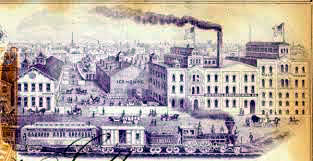
mcavoy

The Chicago Tribune of 1897 refers only to 23rd street.   From other sources we learn that the brewery was at 23rd Street and South Park Way, now Martin Luther King Drive.


An article in the Chicago Tribune dated October 7 1900 described the location only as:…Twenty second Street and Prairie….long been obliberated by the handsome residences in that section of the city.”Colbert describes the location as being at about 23rd and Wabash Avenue. This conflicts with two or three other estimated locations.

In 1937 a bronze plaque was placed at the 23rd Street viaduct over the Illinois Central Railroad. The inscription reads “First City Cemeteries – This was the site of one of Chicago`s first two cemeteries, and comprised sixteen acres. It was laid out in August, 1835, and enclosed in September, after which burials elsewhere on the south side were forbidden. – Erected by Chicago`s Charter Jubilee – Authenticated by Chicago Historical Society – 1937.” Reports state that an identical plaque was to designate the North Side Cemetery of 10 acres on Chicago Avenue, east of Clark Street, but there is no confirmation that it was put in place.

Based upon these descriptions, A best guess for the sixteen acre cemetery could have been bounded by 22nd on the north, 23rd on the south, Cottage Grove on the west, and Lake Michigan shoreline on the east.  The cemetery was as unpopular as the North Side Cemetery and was closed by the Common Council in 1843. They ordered all graves moved to the new Catholic Cemetery at State Street and North Avenue (1600 north). This task was reported to have been completed by 1847.

Reference: Chicago Tribune, Aug 8, 1897. By 1847, the corpses remaining at 23rd street had all been removed to Lincoln Park.

But as we well know, despite best efforts, early burying grounds never seem to be completely removed as intended. The Tribune of 1897 stated “It was only a few weeks ago that in excavating for a building on the south side, the laborers found three well preserved graves, evidently not those of red men. Upon investigation, it was learned that the bodies had been interred over half a century ago in a corner of an old cemetery situated at Twenty-Third Street.”


Both cemeteries were replaced by City Cemetery now Lincoln Park, a subject all its own.


Chicago: A city built on graves

There have been an  incredible amount of early burials in the downtown area of Chicago. Many could be thought of as the earliest “backyard” burial, where the first Chicago residents simply buried their deceased where they lived. Many others were native Americansac3ce9a011293bf6d295e01e99c922da--nephilim-giants-human-skeleton.

Bodies most everywhere

Both Native Americans and early Chicago settlers buried their dead in or along the Chicago riverbank. The Tribune of 1897 state:

“..that all along both sides and partly under its present bed, from Market Street to Dearborn or State, bodies of early Chicagoans are thickly laid.”

 Andreas, in his History of Chicago, used the phrase “..all along the borders of the two branches….on or near the residence of the friends of the deceased.” 

The Daily Democrat reported :

“Two coffins seen floating down the river (were) supposed to have been from some burying ground on the North Branch of the Wabansia Division.” One early observation was of a boatman paddling up the river who saw the ends of bark coffins projecting from the sand hills on the right bank…and even occasionally noted their contents.”


As early as 1897, the Chicago Tribune printed an article entitled:

 “City built on Graves – Chicago buildings stand upon sites of old cemeteries…the structures of the downtown district cover unnumbered dead.”


John Kinzie’s home along the Chicago river might be considered one of the earliest sites for a backyard burial.  John Kinzie (1763-1828) remained at the house until his death on January 6, 1828 when Chicago’s population was only about forty people.

Kinzie_House


Jean LaLime Buried by Kinzie

Andreas described the La Lime burial site as being “near the bank of the river about the present terminus of Rush Street and within about 200 yards (600′) of Mr. Kinzie’s house, in plain view from his front door and piazza.”  This grave was also mentioned in The Fort Dearborn Massacre by Helm, published 1912.


This is (or was) the burial site of Jean LaLime, (  -1812) an interpreter at Fort Dearborn who was killed by John Kinzie (1763-1828) in a dispute early in 1812. Although Kinzie was cleared of any wrongdoing, it is reported that his feelings of guilt prompted him to have LaLime buried near the Kinzie home. According to The Story of Old Fort Dearborn by J. Seymour Currey, 1912, the grave was enclosed by a picket fence and cared for by Kinzie and his family. John Kinzie and other family members dutifully placed fresh flowers on the grave.


The Chicago Tribune of 1897 stated As the number of families multiplied, fewer bodies were buried in the neighborhood of the houses, and by 1825 it had become customary to carry the dead to the lake shore just north of the (Chicago) river, and east of the Kinzie home for interment. This spot had been used as a burying ground for the inhabitants of Fort Dearborn.”

1834 Soutrh water street


 And on October 7, 1900 the Chicago Tribune printed the story “Forgotten Graveyards of Chicago – Beautiful Homes built over the tombs of departed Pioneers”


The Chicago Tribune article of  October 7, 1900 describes a cemetery referred to as the “ Common Acre”:  “On the west side, on the North Branch of the Chicago River, north of Kinzie Street, another old cemetery has been obliterated, the ground being taken up for manufacturing sites and business blocks. The remains buried there were taken to burial grounds outside the city limits, as they were at that time, the the cemeteries are now incorporated within the legal precincts of the city.”


 The Daily Democrat refers to “…some burying ground on the North Branch of the Wabansia Division”


 current


How did we forget so many graves and even whole cemeteries?  And where are they?


Did you know the John Hancock building is built upon and near the site of an early burying ground?  The North Side Cemetery, surveyed in 1835, included a portion of prime North Michigan Avenue real estate including the Hancock Building and Water Tower Place.


A portion of Lincoln Park, the beautiful park along Chicago’s lakefront, was once City Cemetery, the primary municipal burying ground for Chicago between 1837 and about 1871.  Most bodies were removed after the Chicago Fire, but many still remain buried there. Over the years, human remains have often been found in Lincoln Park and in the Gold Coast neighborhood during construction or repair projects. Most of the God Coast area  bodies were from where Catholic Cemetery was located. Today, the Cardinal’s mansion now stands on the north end of that site.


Other cemeteries existed near and under portions of the McCormick Place complex, under the University of Illinois Circle Campus, under housing developments, and under many city streets. Construction crews often discover human remains during street and sewer work.

In future blogs I will describe how the city began to consolidate bodies in two municipal cemeteries.

But for now, think twice as you walk in and enjoy the downtown and northside area. There just may be someone under your feet!

Chicago area Undertakers

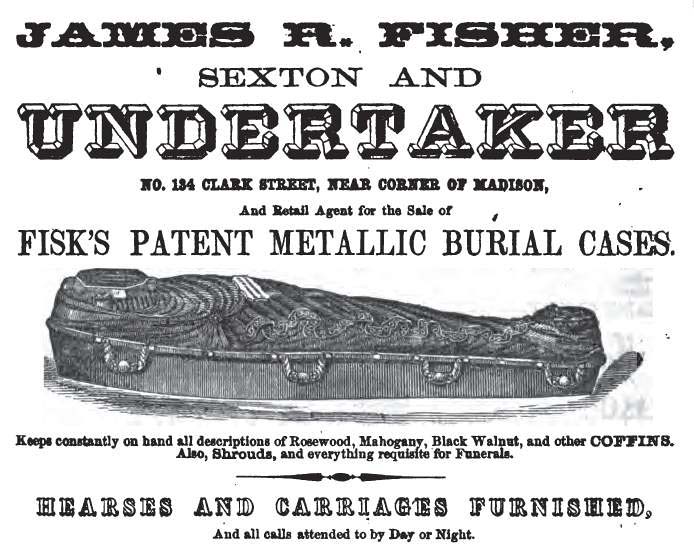
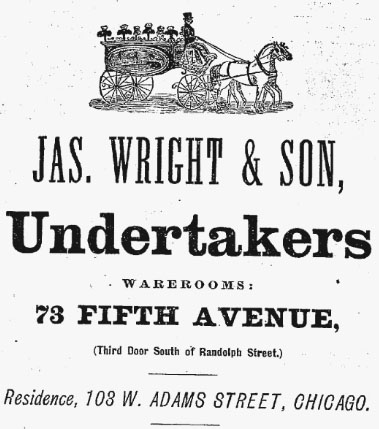
Hundreds of small undertakers operated in Chicago and Cook County out of storefront establishments providing services and funeral merchandise.

Many early undertakers were in downtown storefronts on Madison, Wells (formerly Fifth Avenue) as well as main arteries and streets such as Clark,  State, Halsted, Lincoln, Milwaukee, Archer, North, and Wells wright Continue reading “Chicago area Undertakers”

Finding your Uncle Louie

Tips on finding the Burial Location of your Relative


There are over ten thousand burial locations in Illinois, 272 in the Chicago area alone.. They provide an important physical link to our past containing a wealth of genealogical information. They provide a unique insight into our customs, beliefs, and culture. If you want to learn about people, study their cemeteries. For the beginning or advanced genealogist, cemeteries can help when other sources fail. You may discover infants that were born and died between census years. You may discover an aunt or second wife, not known about.


If you are looking for YOUR Uncle Louie who has seemingly disappeared or you simply do not know where he is buried,  Here are thirteen steps:

  1. Start by writing down what you know. It might be a death date or a funeral remembered. It might simply be a family story of where the person was last seen. Write down the name of a spouse, or children. Write down or even guess at the birth date. You need first to simply create the best profile of the person. Small clues can be very helpful.


  1. Check and recheck your family records. Look at wills, letters from or to family members, obituary clippingsor deeds. Don’t overlook family bibles, scrapbooks, and diaries for clues. Interview older family members. You may discover birth certificates, baptism records, or any number of valuable documents.                                      
  2. Build or reread the profile of the person you are searching for. This will aid in determining the cemetery in which they may have been buried. People are predictable, creatures of habit. They follow patterns consistent with the customs of the time. Residence, church membership, employment all will help you establish a idea where and when the person resided. Even in a city as large as Chicago, residents maintained strong ties to neighborhood, most often by ethnic origin.
  3. Narrow your estimate of the death date. Knowing the death date will allow you to rule out cemeteries that have not yet opened, cemeteries that were inactive, or those that had reached capacity at the time. The month of death can sometimes be a clue. A death during a harsh winter might mean temporary interment tin a cemetery that had a holding vault. Bodies were often held until spring when the ground thawed enough for digging the grave.                                                                                            
  4. Look for a death certificate. Familysearch.org is a free website. Register for free. Ancestry, a subscription site is also a good resource.

 6. Try to determine the last residence. Burials are often made in some proximity to the residence or neighborhood of the deceased. Although there are numerous exceptions to this rule, start your search in cemeteries that served the neighborhood or town of the deceased. As a general rule, the older the burial date, the more likely it will be in closer proximity to his or her last residence. As late as the end of the 19th century, burials were still made in urban areas near the home or residence. Although zoning lawsput an end to this practice within the city, farm burial plots are very common, many of which have vanished from our memory and records.


  1. If religion was important in their life, try to determine the religious affiliation of the person. Death and burial often follow the customs, rites, and beliefs of the church. The religion of the deceased often influences the choice of burial location. The Catholicand Jewish faiths consecrate individual graves and entire cemeteries. Members are usually obligated to be buried in consecrated ground. Church related cemeteries are usually easier to identify, although some have lost their identity through the years. If the person you are searching had little or no religious affiliation, try the municipal or community cemetery. If there is a history of Fraternal membership,seek those cemeteries that provided space for fraternal lodges and societies.


  1. Determine the economic position of the person you are searching for. There are cemeteries for both the poor and the rich. Fashionable families, politicians, and the famous often buried their dead in Rosehill, Oakwoods, and Graceland. The poor were buried in potters fields throughout the city. Knowing the economic status will help you identify a potential cemetery.


  1. Think about the customs and practices of the family. Did they move often? Were they long time residents of the community?. Along time resident may have been more apt to have selected a burial location well in advance. A family with less “roots” may have just chosen the most convenient cemetery. Families who migrated from other areas might return a body back home. Depending on the time of death, consider the possibility of cremation. If the person was a victim of an epidemic or disaster, the burial might have been made in a special section in the cemetery.


  1. If the death certificate or other documents have not yielded a burial location, identify all the cemetery possibilities that fit the profile of the person you are searching. You can rule out many cemeteries, such as those cemeteries opening after a death date.


  1. Write or call these cemeteries. Although many cemeteries will help you without charge, some will charge for the service, others discourage genealogical research. Be polite, specific, and make only reasonable requests. If the cemetery is church related, a donation or offer of a donation is always a good idea.


  1. If you have located a family member in a particular cemetery, plan an in person visit to seek additional information. Choose good weather for your cemetery visit. Wear comfortable, protective clothing especially for visiting cemeteries that are in poor condition. Be safe. Some cemeteries may be in less than desirable neighborhoods. Follow your instincts. Leave you are not comfortable in a particular area. Avoid isolated areas unless you have someone with you. Get permission if the cemetery is on private land. If there is an office, they can often locate the grave on a map for you. Some cemeteries will allow you to examine their record books. At the gravesite, the stone or marker may reveal additional information not in cemetery records. On some occasions, there may even be conflicting information. Nearby stones and markers may reveal other family members, wife or husband, children, parents, grandparents, aunts or uncles.


  1. Try locating a transcription of the gravestones or the records. The Daughters of the American Revolution, local genealogical groups, and historical societieshave carefully copied and published thousands of cemeteries. Always try to verify any information found in a transcription with that of a primary source such as a death certificate or cemetery record.

With patience, persistence, and a bit of good luck, you will find the burial location of your missing relative. With a bit more effort and luck, you will find additional and valuable genealogical information from the gravestone, cemetery records, or the death certificate itself.


If you have hit a brick wall, email me with what you know and I will try to help. I have many research tools at my disposal. Barry A Fleig bartonius84@hotmail.com