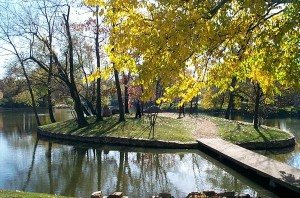
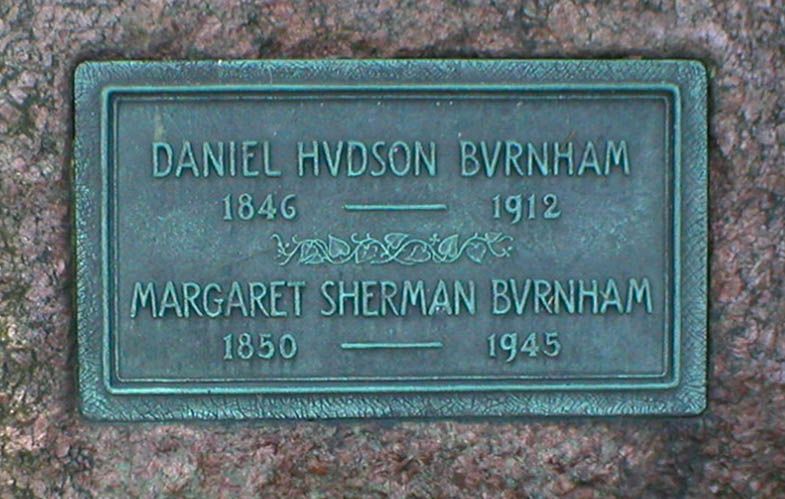
He and his wife are buried beneath a glacial boulder on the very small island in Lake Willowmere. The seven-acre lake was designed by Ossian Cole Simonds (1855-1931) and William Le Baron Jenney (1832-1907) and was one of three planned and constructed water features on the grounds, Lake Willowmere is the only remaining one today.
You can find the lake on the north end of Chicago’s famous 120 acre Graceland Cemetery at 4001 North Clark St. which was founded in 1860 by attorney Thomas B. Bryan (1828-1906), designed as a “rural” cemetery, a parklike atmosphere so different from conventional grid cemeteries.
The lake is surrounded by the monuments of Chicago’s social register. There is the massive Potter Palmer monument built for his wife Bertha, Kenneth Sawyer Goodman (1883-1918) playwright and namesake of the of the Goodman Theatre , Charles H. Wacker (1856-1929) of Wacker Drive, Ernie Banks (1931-2015), Getty, Ludwig Mies Van Der Rowe, and others.
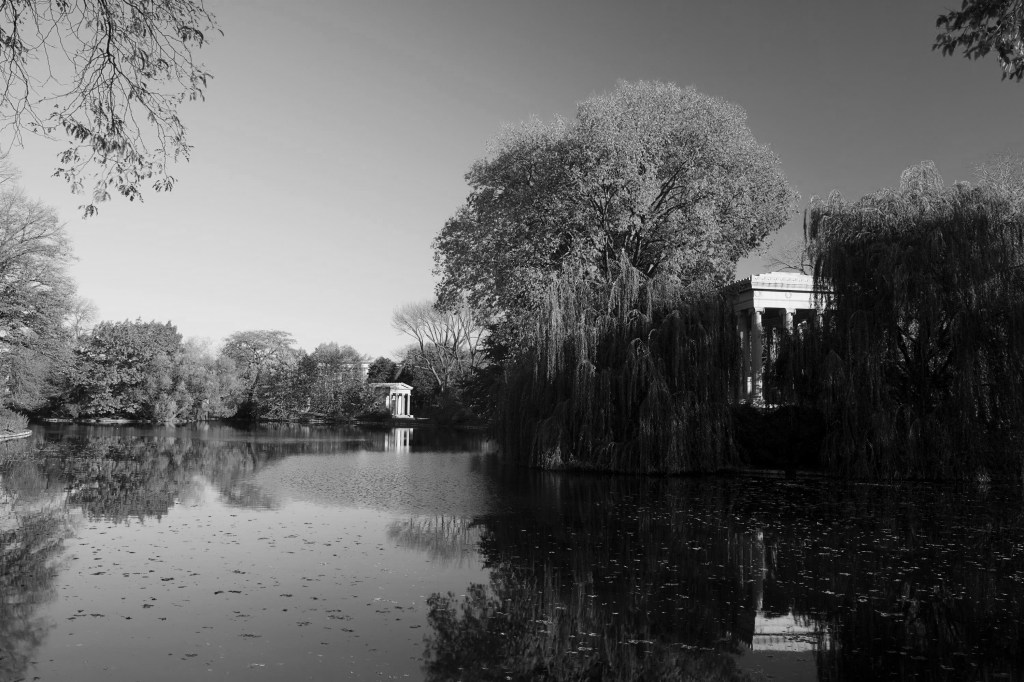
Those buried around the lake were of course famous, rich or both. In Eric Larson’s novel, Devil in the White City, he wrote of the dead buried around Lake Willowmere with the words, “On a crystalline fall day you can almost hear the tinkle of fine crystal, the rustle of silk and wool, almost smell the expensive cigars.”
The man underneath that boulder on the island died on June 1 1912 at age 65 while traveling with friends in Heidelberg Germany and was one of Chicago’s most famous citizens. There is a harbor named after him. He authored a famous plan for Chicago. He is best known for the famous quote “make no little plans” although he may or may not have actually said it.
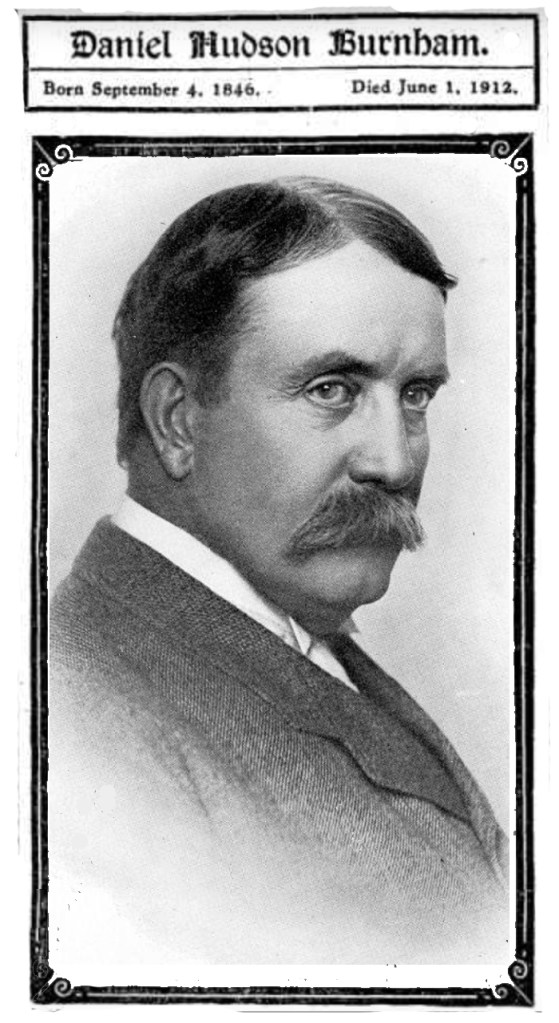
His name of course is Daniel Hudson Burnham, one of the most influential architects in American history and is known as “The Father of American City Planning”. He was born September 4, 1846 in Henderson, Jefferson County, New York.
Failing to get into college, young Burnham became an apprentice draftsman under the famed architect William LeBaron Jenney, the “Father of the American Skyscraper”.
After the Chicago fire of 1871, he and his partner John Wellborn Root (1850-1891) helped rebuild Chicago. Burnham was the dreamer and politician while Root was an astute draftsman. Burnham devoted two years of his time as the Director of Works for the World’s Columbian Exposition of 1893 celebrating Columbus’s voyage to discover America.
He became an extraordinary city planner best known for his 1909 “The Plan of Chicago“, the first master plan for the careful growth of an American city. He envisioned Chicago becoming a “Paris on the Prairie,” with French-inspired public works, fountains, and tree-lined boulevards
He contributed so much to the city of Chicago designing many famous buildings, including Chicago’s Masonic Temple, the Rookery, the railway exchange, the insurance exchange, Marshall Field store, The Monadnock building and others. Across the country he designed the Flatiron Building in New York City the Kansas City Board of trade, the Mills building in San Francisco. Union Station in Washington DC, Wanamaker’s store in New York City.
Daniel Burnham had lived at 232 Dempster in Evanston. In 1938 the Burnham house was demolished and the property subdivided into Burnham Park, consisting of nineteen lots with a center alley that was not to be built upon, but left open to nature. Today, all that remains of Camp Burnham is the eastern section of the concrete terrace wall, and the Tea House, which, along with later additions, is now a private home.

His wife was Margaret Sebring Sherman (1850-1945) , his three sons, Daniel Burnham Jr. (1886-1961) John (1878-1963), Hubert (1882-1968).and two daughters Ethel Burnham Wells (1876-1949) and Margaret Sherman Burnham Kelly (1884-1971). All except Ethel buried in Graceland Cemetery.
And as Paul Harvey would often say “now you know the rest of the story”
If you have enjoyed this story, please leave a comment below, and I invite you to subscribe so that you will receive notification of the many upcoming stories about Chicago and Chicago cemeteries. Subscribing is free.
You can also contact me at bartonius84@hotmail.com
And while you’re at it, check out this related story
Ten Cemeteries and Wrigley Field – Chicago and Cook County Cemeteries
 Chicago and Cook County Cemeteries
This was so interesting. I have relatives buried at Graceland, and I find it a very interesting cemetery.
LikeLike