
Where were you on Tuesday September 22 1959? I was just 15 years old and a sophomore at Lane tech high school
It was a time when we were concerned about the Cold War with the Soviet Union.
Premier Nikita Khrushchev was visiting in San Francisco. On television, Alex Dreyer delivered the evening news, followed by “To Tell the Truth”, the Andy Williams show and Jack Paar. You could watch “Diary of Anne Frank” at the movie theatre or the Blood of Dracula at a drive-in. You could fly to New York for $23. A T-bone steak was $1.09 a pound. A loaf of bread was $.20. A postage stamp was .04. It was the year of those giant fins on cars.
. I was sound asleep in the middle bedroom because the next day was a school day.

But the big event was on WGN radio from Cleveland Ohio where announcer Jack Brickhouse was broadcasting the White Sox playing the Cleveland Indians for the American League pennant. . Although WGN broadcast Cubs and the Sox games on television, they did not broadcast “away” or night games.

At 9:41 PM in Cleveland Ohio the White Sox had just won that American League pennant, beating the Cleveland Indians 4 to 2. This was a big deal because The Sox had not won a league championship since 1919.
But wait there’s more!
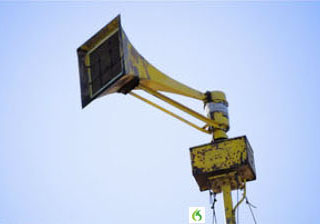
And then, every Chicago air-raid sirens on schools and firehouses, the city’s emergency warning system began to wail in celebration of the White Sox’s win and continued for five minutes.

The sirens scared the daylights out of a lot of people and triggering fear in thousands of Chicagoans. But instead of celebrating in Chicago, many citizens ran out into the streets or hid in their closets, thinking something awful had happened. Mind you, this was amid that Cold War when the real purpose of the sirens were to warn us against a nuclear attack.

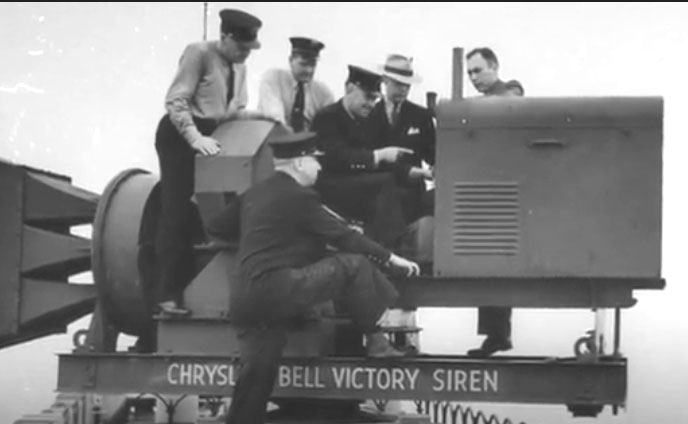
In 1941 Before the sirens, the fire and police departments used vehicle sirens and gongs. Then in 1942, vehicle sirens were replaced by the massive engine-powered Chrysler Victory Bell siren which were bolted to the rooftops of schools and firehouses and weighed nearly 3 tons. They used a powerful 180 horsepower V-8 hemi gasoline engine. Their excruciating weight and its gas engine proved to be a serious problem problem.
On Oct. 8, 1942, one of the Chrysler engines exploded on the roof of firehouse engine company 36 on North Kedzie Avenue.during an air raid drill, setting fire to the roof of the firehouse .One firefighter was injured and another died from his injuries when they jumped from the roof while fighting the fire.
Those sirens were they were replaced by the 10-horsepower model 1000 Thunderbolt siren using compressed air. It was usually bright yellow, huge and crazy loud , you could hear them for miles. By 1950 there were 50 sirens across Chicago with 14 of them in the downtown loop. Later there were a total of 78 sirens.

It was the siren of choice by many Civil Defense authorities and emergency management agencies from the early 1950’s through the late 1970’s. Built by Federal Signal, the Thunderbolt was introduced in 1952 during the beginning of Cold War tensions as primarily an attack warning siren. Federal Signal phased out the Thunderbolt series by 1990. Of all the sirens produced during the Cold War era, the Thunderbolt has the most distinctive and recognizable design.

Most Chicagoans heard them being tested weekly, every Tuesday at 10:30 AM. it was so loud, they could be heard inside a building.
So on that night of September 22, 1959 the sirens wailed! All of them!

Mayor Richard J Daley and Robert J Quinn the fire Commissioner were huge White Sox fans. Da Mayor said the sirens had been sounded “in the hilarity and exuberance of the evening. After 40 years of waiting for a pennant in the American League, I assume that everyone who was watching the telecast was happy about the White Sox’s victory.”
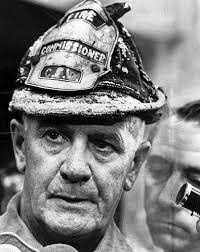
Chicago fire Commissioner Robert J Quinn apologized. “This was intended as just a tribute to a great little team that brought Chicago a pennant, and there was certainly no intention to frighten people. I feel bad about this. If it inconvenienced any people or upset them, then I am sorry.”
But then on another occasion he said, “If the Sox ever win another pennant, I’ll do it again,”
all of those sirens did not help the White Sox win the 1959 World Series. They lost to the Los Angeles Dodgers on October 9, 1959 at Comiskey Park. No sirens were heard that night.
If you were around in 1959 and remembered the sirens, please comment below.
For another story about Robert Quinn click on this link:
The Battered Helmet – Chicago and Cook County Cemeteries
and for more about growing up in Chicago in the 1950s:
Growing up in Chicago in the 1950’s – Chicago and Cook County Cemeteries

 Chicago and Cook County Cemeteries